Diary
Loving the lichen
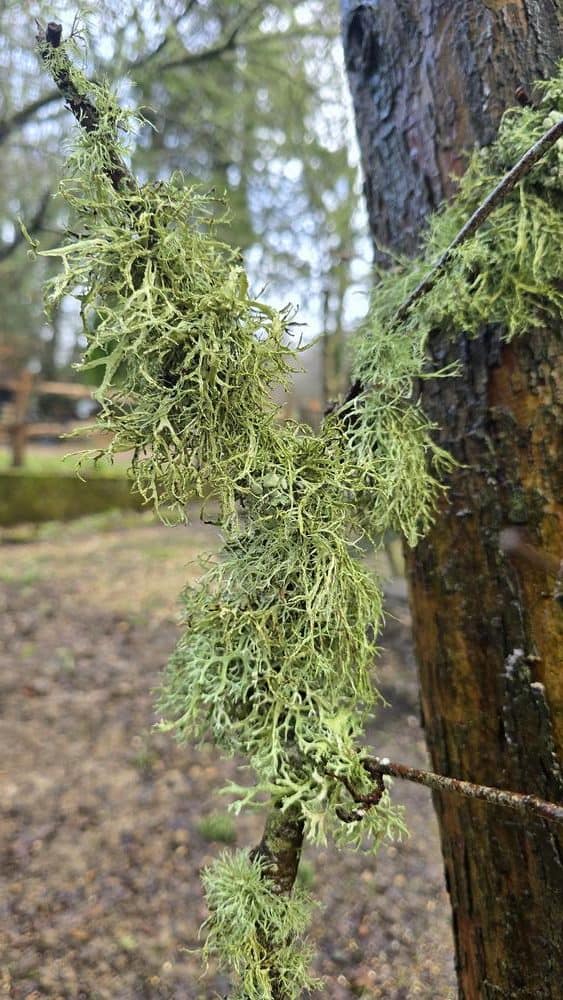
To me, lichen looks almost more like seaweed than anything else – that sense of movement and the ever-stretching tentacles.
It’s always said that a good presence of lichen indicates good air quality, and it’s true that in this part of East Sussex we are fortunate enough to be able to breathe deeply and almost taste the goodness. But I didn’t realise until recently that lichen isn’t even a plant – it has no leaves and no roots.
It turns out that it’s not even a single thing – lichen is made of two or three different parts. There’s always a fungus. This is what you’re seeing in this picture, that weird, tendril-laden, almost creature-like shape. Of course, we’re used to seeing – and eating – fungi (think of mushrooms). Any woodland in the autumn is likely to be covered in fungi, and the fungi help fallen trees to decompose.
So, the fungus reproduces and grows – but it has no way to photosynthesise, so no way to feed itself.
For that, the fungus needs an algae. According to Wikipedia, algae is “an informal term for any organisms of a large and diverse group of photosynthetic organisms that are not land plants”….. So not a land plant at all. Most algae are, in fact, waterborne, and the largest of them are known as – guess what? Seaweed! So that’s why lichen always reminded me of seaweed! It basically is a land-growing form of seaweed, with the shape provided by the fungus in this marriage of convenience!
So, we take a toadstool, add a layer of seaweed, and hey presto, our branches, damp from all the recent rain, are covered in this incredible lichen, which we can use to find out whether the air is good or not!
You just have to love nature.